
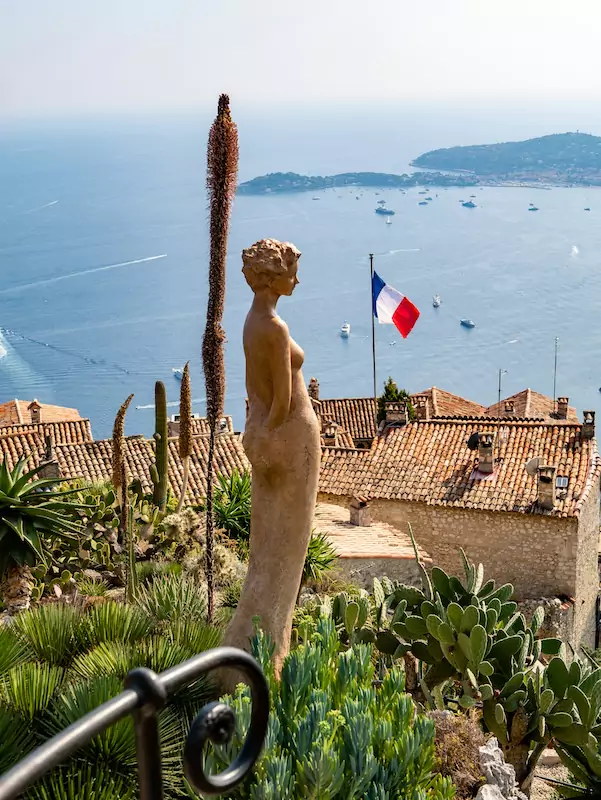



The top of Èze is 429 metres above the Mediterranean, and you can see almost all of it from there: the bay of Villefranche to the west, Cap Ferrat, and on a clear morning the coast running east past Monaco toward Italy. The village below the summit is a knot of stone lanes on a rock spur between Nice and Monaco, small enough to walk end to end in twenty minutes and steep enough that no cars go inside the walls. It is one of the most visited villages on the French Riviera, which is why timing matters more here than almost anywhere else on the coast.

A fortress the House of Savoy built and Louis XIV knocked down
People lived on this rock long before the Middle Ages, but the village you walk through is medieval. By 1388 Èze had passed to the House of Savoy, which turned it into a fortified stronghold facing the sea. In 1706, during the War of the Spanish Succession, Louis XIV's troops destroyed the castle and most of the ramparts. What survived is the double gateway at the entrance, the lanes that wind up to the summit, and houses built so tightly against the rock that they read as one wall from below.
The oldest building is the Chapelle de la Sainte-Croix, dating from 1306, where the White Penitents brotherhood met. The ochre baroque church of Notre-Dame-de-l'Assomption, built from 1764, is newer and much larger, and its bell tower is the landmark you see from the Corniche road. Inside the walls, the lanes are lined with galleries and craft shops; most are aimed at day-trippers, so look at the open workshops rather than the souvenir racks.

The garden on the castle ruins
The summit, where the castle stood, is now the Jardin Exotique d'Èze. It was laid out in 1949 by Mayor André Gianton with Jean Gastaud, who also created the exotic garden in Monaco. Cacti and succulents from the Americas and Africa grow on terraces cut into the rock, and a northern section, planted with Mediterranean species, opened in 2014. Between the plants stand the clay goddess figures by the sculptor Jean-Philippe Richard.
The garden is the only part of the village with an entry fee, and it is the reason to come. From the old castle walls at the top, the view runs from Cap Ferrat to Italy. Go at opening time: by late morning in summer, the narrow paths queue up behind tour groups. Tickets can be bought on the garden's website.

Perfume at the foot of the village
Grasse, the perfume town, is an hour's drive west, but Èze has its own stop. The Fragonard laboratory factory, on avenue de Verdun near the village square, offers a free guided tour showing how perfumes and soaps are made, according to the regional tourism board; paid workshops where you blend your own scent need booking. If the subject draws you in, our guide to Grasse and its perfume houses goes further.

Where to eat, from socca to two stars
The serious table is La Chèvre d'Or, in the hotel of the same name built into the ramparts. As of the 2026 Michelin Guide, chef Arnaud Faye's restaurant holds two Michelin stars; book well ahead and ask for a table by the window. For a cheaper lunch, the cafés near the entrance gate serve Niçois staples: socca, the chickpea-flour pancake, pissaladière, an onion tart with anchovies and olives, and salade niçoise. A glass of Provence rosé is the local match.
The Nietzsche path down to the sea
Èze village sits above Èze-sur-Mer, the seaside part of the commune with its own train station. The Chemin de Nietzsche links the two: a stony mule track through pine and scrub, named after the philosopher, who walked it during his winters in Nice. Walking down takes about an hour and is the better direction for most knees. Wear proper shoes, carry water, and skip it in the midday heat of July and August.

Plan your visit
- By bus from Nice: lines 82 and 602 leave from the Vauban bus station and take about 30 minutes to the village (as of November 2026, per Lignes d'Azur). Line 600 goes to Èze-sur-Mer by the sea instead, which leaves you at the bottom of the hill.
- By train: TER trains on the Nice to Monaco line stop at Èze-sur-Mer station; from there, walk up the Nietzsche path or take a bus up.
- By car: park in the paid car park at the foot of the village, then climb on foot.
- When to go: April to June and September to October, early in the day. In July and August, arrive before the cruise-ship coaches from Villefranche and Nice.
- Information: the Èze tourist office on place du Général-de-Gaulle has current hours for the garden and the churches.
Start at the garden when it opens, while the view toward Italy is still clear, then work your way down through the lanes and finish with lunch or the walk to the sea. More Riviera ideas are in our Roam travel guides, and our free France travel guides cover the rest of the coast.

French and based in Vancouver since 2014, Julien Mainguy is the co-founder of Best of France. Passionate about the cultural difference between Canada and Europe, he is leading numerous projects to create awareness, help people grow, and bring communities together.