



The Eiffel Tower was supposed to come down after twenty years. Mont Saint-Michel was a prison for decades. Notre-Dame nearly burned to the ground in 2019. The ten monuments below are the ones you would recognise from their silhouette alone, and each has a story that most visitors walk past. Here is that story, monument by monument, with a pointer to the official site for planning.
1. Palace of Versailles: Louis XIV's stage
Versailles began as a hunting lodge. From the 1660s Louis XIV had his architect Louis Le Vau enlarge it, and later Jules Hardouin-Mansart added the Hall of Mirrors, where 357 mirrors face the windows onto the gardens. The court moved here in 1682, and the palace grew until the Revolution forced the royal family back to Paris in 1789. The estate has some 2,300 rooms and has been a UNESCO World Heritage Site since 1979.

2. Eiffel Tower: built to be temporary

Gustave Eiffel's company built the tower for the 1889 Exposition Universelle, held for the centenary of the Revolution. It was the tallest structure in the world until New York's Chrysler Building passed it in 1930. Its permit ran for only twenty years, and it was saved by radio: the antenna on top proved useful to the French army, and the city kept it. Today the top floor is the highest observation deck open to the public in the European Union. Book a timed ticket on the official Eiffel Tower site rather than queuing.
3. Notre-Dame de Paris: rebuilt in five years
Notre-Dame took nearly two centuries to build, from 1163 into the 14th century, and became the model of French Gothic, with its flying buttresses, rose windows and gargoyles. Victor Hugo's 1831 novel, known in English as The Hunchback of Notre-Dame, helped save it from neglect in the 19th century. On 15 April 2019 a fire destroyed the roof and the spire. After five years of restoration, the cathedral reopened in December 2024, with a new spire built to the 19th-century design. Entry is free and no reservation is needed; check opening hours on the cathedral's website.

4. Sacré-Cœur: a vow after defeat
The white basilica on Montmartre was built as a national vow after France's defeat in the Franco-Prussian War of 1870. Construction began in 1875 and was finished in 1914, but the consecration waited until 1919, after the First World War. It stands on the highest hill in Paris, about 130 metres above sea level, and its dome is visible from much of the city. Climb the steps or take the funicular, then walk the back streets; our guide to Montmartre and its artists shows where.

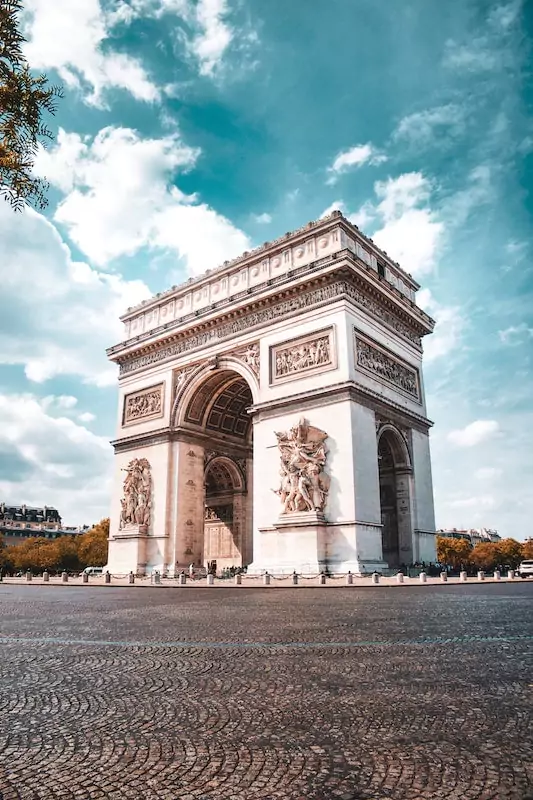
5. Arc de Triomphe: thirty years to finish
Napoleon ordered the arch in 1806 to celebrate his armies, modelled on the triumphal arches of ancient Rome. He never saw it finished: it was inaugurated in 1836, under Louis-Philippe. Since 1921 the Tomb of the Unknown Soldier has lain beneath it, and the flame is rekindled every evening. Visitors can climb to the roof for one of the best views of the twelve avenues radiating from the Place Charles-de-Gaulle. Arches inspired by it stand in Bucharest and elsewhere.

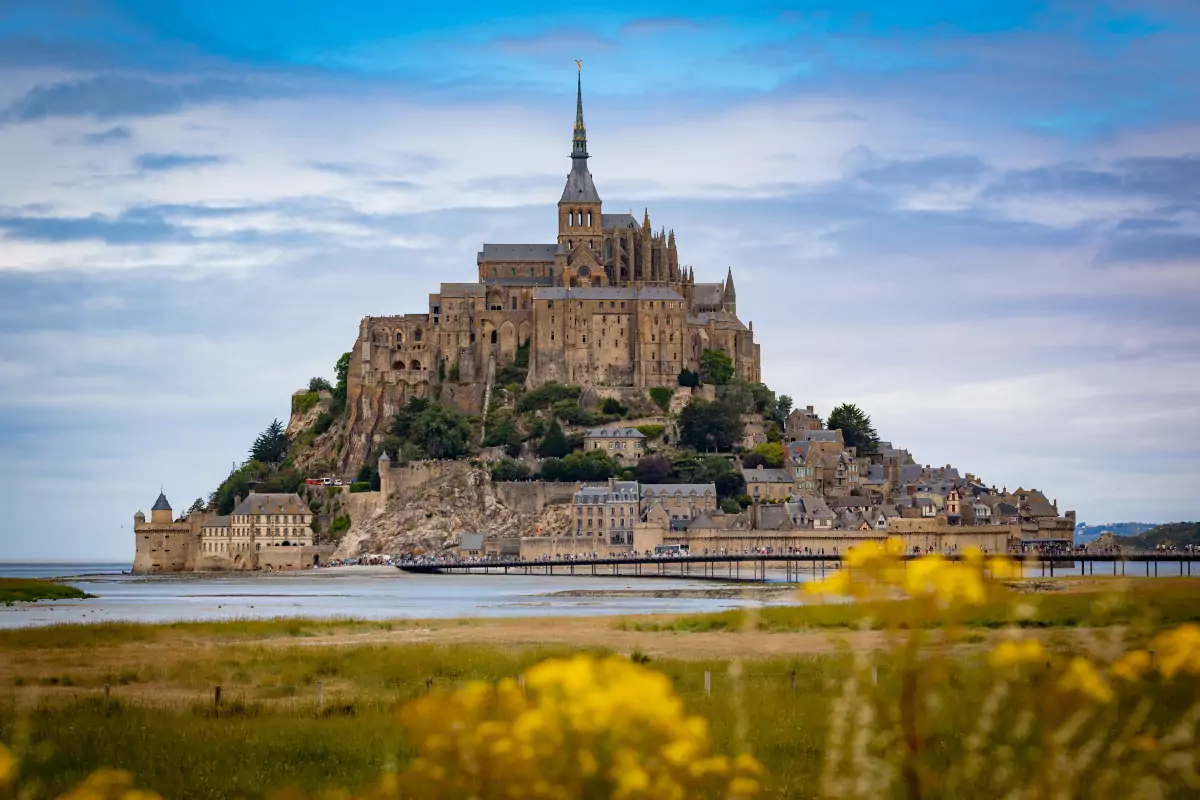
6. Mont Saint-Michel: abbey, fortress, prison
According to tradition, the Archangel Michael appeared to Bishop Aubert of Avranches in 708 and asked for a sanctuary on this rock in the bay. Benedictine monks arrived in 966, the English failed to take it during the Hundred Years' War, and after the Revolution the abbey served as a prison until 1863. The Mont is a tidal island: the sea can surround it at high tide, and since 2014 a bridge-walkway links it to the mainland. Our guide to Mont Saint-Michel in five minutes covers tickets and tides.

7. Notre-Dame de la Garde: Marseille's Bonne Mère
The basilica crowns the highest point in Marseille, a hill of about 150 metres above the Vieux-Port, on the foundations of a 16th-century fort. It was built between 1853 and 1864, and the gilded statue of the Virgin and Child on its bell tower can be seen from the sea. Marseillais call it La Bonne Mère, the Good Mother, and sailors left ex-votos inside. The interior, with its mosaics and striped marble, was restored between 2001 and 2008.

8. Château de Chambord: a hunting lodge for a king
Chambord was begun in 1519 for François I as a hunting lodge in the forests of the Loire. It is the largest of the Loire châteaux, and its centrepiece is the double-helix staircase: two spiral stairs wind around each other so that people going up and down never meet. Leonardo da Vinci, who spent his last years at nearby Amboise, may have inspired the design, though no document proves it. Our guide to the Loire Valley castles puts Chambord in context.

9. Château du Haut-Kœnigsbourg: rebuilt by a Kaiser
This red sandstone castle above the Alsace plain dates back to the 12th century and was ruined during the Thirty Years' War. When Alsace was part of the German Empire, Kaiser Wilhelm II had it rebuilt between 1900 and 1908 as an imperial symbol, and for years the French regarded it with suspicion. It passed to France after the First World War and is now one of the most visited sites in Alsace.

10. Carcassonne: the medieval city Viollet-le-Duc restored
Carcassonne's Cité has 3 km of walls and 52 towers on a hill above the Aude. By the 19th century it was crumbling, and the architect Eugène Viollet-le-Duc led a long restoration, adding the pointed slate roofs that still divide historians. It has been on the UNESCO World Heritage List since 1997. Read our guide to exploring Carcassonne before you go.

Plan your visit
Six of these ten are in or near Paris and can be seen in a few days; the other four make good anchors for a road trip. For the Paris monuments, book timed tickets online in advance in summer, especially for Versailles and the Eiffel Tower, and check closing days: the Palace of Versailles is closed on Mondays. Opening hours change by season, so confirm on each monument's official site the week you go.
Start with the Eiffel Tower, the monument that was meant to last twenty years and is still standing after more than a century. More itineraries are in our Roam travel guides, and our free France travel guides help you plan the trip around these ten.

French and based in Vancouver since 2014, Julien Mainguy is the co-founder of Best of France. Passionate about the cultural difference between Canada and Europe, he is leading numerous projects to create awareness, help people grow, and bring communities together.