


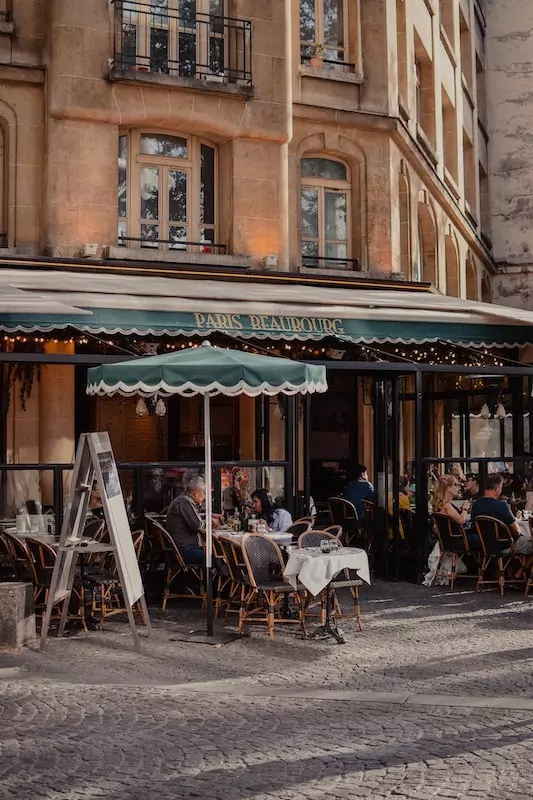



The word is French, and so is the vocabulary still printed on many tables: rouge and noir, pair and impair, manque and passe. Roulette, "little wheel", was being played at the Palais-Royal in Paris by the 1790s, and a book published in 1801 describes it there. What makes a table "French" today, though, is less the language than two small rules that change the arithmetic in the player's favour. Here is where the game came from, how its bets work and why the French version keeps the smallest house edge.
From the Palais-Royal to Monte Carlo
A popular story credits the mathematician Blaise Pascal with inventing a primitive wheel in the 17th century while chasing a perpetual-motion machine. Historians treat that as a possibility, not a fact. The documented record starts later: Jaques Lablée's La Roulette, ou le Jour, published in 1801, describes the wheel at the Palais-Royal in 1796, then the centre of Parisian gambling.
The game took its modern form outside France. In 1843 in Bad Homburg, a German spa town, the French brothers François and Louis Blanc introduced a wheel with a single zero to draw players from rival casinos whose wheels had two. When Germany banned gambling, the Blanc family moved to Monaco, and the single-zero wheel became the signature game of the Casino de Monte-Carlo. Today the game is offered in casinos around the world and on online platforms, such as this site for Canadian players, alongside other classic table games.

How the wheel and the table work
A French wheel has 37 pockets: the numbers 1 to 36, alternating red and black, and a single green zero. The croupier spins the wheel one way and the ball the other, and players bet on where the ball will stop. The numbers on the wheel are not in order; they are arranged so that high and low, odd and even, red and black alternate as evenly as possible.
On the felt, the same numbers are laid out in a grid of three columns. Bets placed on the numbers themselves are called inside bets; bets on groups along the edge of the layout are outside bets.
The bets, and what they really pay
The most direct bet is a single number, en plein. It pays 35 to 1, but with 37 pockets the chance of hitting it is 1 in 37. That gap between the true odds and the payout is where the casino's edge comes from. Split bets on two numbers, streets of three and corners of four pay less, in proportion.
The outside bets cover larger groups: red or black, odd or even, low (1 to 18, manque) or high (19 to 36, passe). They pay even money, 1 to 1, but they are not 50-50 chances. The zero is neither red nor black, neither odd nor even, so each of these bets wins on 18 of the 37 pockets. Dozens and columns pay 2 to 1 and win on 12 of the 37.

Why French roulette has the smallest house edge
The house edge is the share of all money wagered that the casino keeps over the long run; its mirror image is the "return to player". It describes millions of spins, not your evening: in a single session anything can happen, and the edge still applies to every bet.
On a single-zero wheel the edge is 2.70 percent. American roulette adds a second green pocket, "00", which raises it to 5.26 percent. That one extra pocket nearly doubles what the house keeps.
French tables go one step further with two rules on even-money bets. Under la partage, if the ball lands on zero, you lose only half of an even-money stake. Under en prison, the stake is held for one more spin and returned if that spin wins. Either rule cuts the edge on even-money bets to about 1.35 percent. Not every table that calls itself French applies them, so the rules card matters more than the name.
A game of pure chance
No betting system changes the result of a spin. Each one is independent: the wheel has no memory, and a run of ten reds makes the eleventh no more or less likely. Doubling up after losses, the best-known "system", only makes losses arrive faster and larger, and table limits stop it anyway. Roulette is entertainment with a known cost, the house edge, and nothing more.

If you do play, treat the money as the price of an evening out, set a limit before you start and stop when you reach it. Rules on online gambling differ from province to province, and you must be of legal age where you live. If gambling stops being fun, your provincial health services run free, confidential help lines.
For another casino game that took a French invention abroad and changed it, read how baccarat changed when it left France. More stories on French history and culture are on Dream, and in our free monthly newsletter.

Born in Lyon (capital of gastronomy), France, Franck moved to Vancouver with his family in 2006 and is currently the co-founder of Best of France. He started a business in the food industry over 10 years ago and has since been actively serving the local French community, and seating at the board of various French associations.