
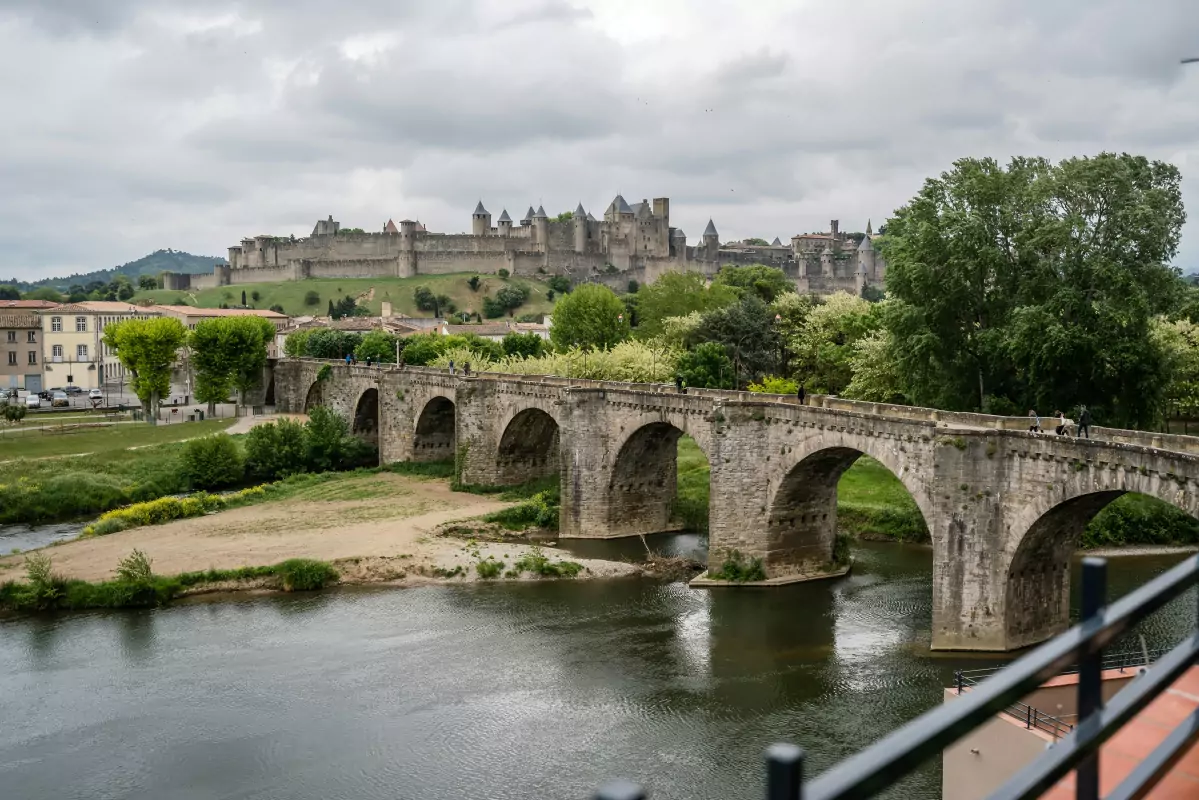




With 3 km of double walls and 52 towers, the Cité de Carcassonne is the image most people have of a medieval French town, and in summer it can feel like all of France is inside it at once. Built on a hill above the Aude River, it was a Roman fort, then the seat of the Trencavel viscounts, then a royal fortress on the border with Aragon. In 1849 the government decided to demolish its walls. Local protest saved them, and the architect Eugène Viollet-le-Duc spent the second half of the 19th century rebuilding what you walk through today. This guide covers what to see, in what order, and how to avoid the worst of the crowds.
Two thousand years in one hill
From Roman fort to Cathar refuge
The Romans fortified the hill, which they called Carcaso, and parts of their walls survive in the inner ring. In the 12th century the Trencavel family built the castle and made Carcassonne a centre of a tolerant southern court, where the Cathars, a Christian movement condemned as heretical by Rome, found protection. That ended in August 1209, when the armies of the Albigensian Crusade besieged the Cité and Viscount Raymond-Roger Trencavel surrendered after two weeks. His lands went to the crusade's leader, Simon de Montfort, and Carcassonne later became a royal stronghold where the Inquisition held its tribunal. In 1355 the Black Prince burned the lower town during the Hundred Years' War but never took the Cité.
Saved, then rebuilt
Once the border with Spain moved south in 1659, the fortress lost its purpose and fell apart. After the 1849 demolition order was reversed, Viollet-le-Duc began restoring the walls in 1853. His pointed slate roofs on the towers are still debated, since the region traditionally used flatter tile roofs, but without him there would be nothing to debate. The Cité was listed as a UNESCO World Heritage site in 1997, which cites both the medieval fortress and the restoration as part of its value.

The castle and the ramparts
Château Comtal: the only way onto the walls
You can walk through the Cité and the lists (the open ground between the two rings of walls) for free. To climb the ramparts and enter the Château Comtal, the Trencavel castle inside the walls, you need a ticket from the monument's official site. The visit takes about two hours and includes the castle's rooms, a museum of stone carvings and a section of the wall walk with its wooden hoardings.

What you see from the walls
From the ramparts, the view runs over the lower town, the Bastide Saint-Louis laid out in a grid in the 13th century, to the vineyards of the Aude and, on clear days, the Pyrenees to the south. Go in the first slot of the morning: by late morning in July and August the wall walk moves at the pace of the slowest group.

The streets of La Cité
The usual way in is the Porte Narbonnaise, the main east gate. If you arrive on foot from the lower town, cross the Pont Vieux over the Aude and climb Rue Trivalle, which leads to the gate. Inside, Rue Cros-Mayrevieille runs from the gate towards the castle and is lined with shops, many selling plastic swords. The side lanes towards the western walls are quieter. Try the local dish, cassoulet, a slow-cooked casserole of white beans, sausage and duck confit; the tourism office lists the regional specialities.

Beyond the walls: the basilica and Place Marcou
Basilica of Saint-Nazaire
The Basilica of Saint-Nazaire, the former cathedral of Carcassonne, has a Romanesque nave from the 11th and 12th centuries and a Gothic choir added around 1300. The choir is the reason to go in: its 13th and 14th-century stained glass fills the east end, and the rose windows face each other across the transept. Entry is free.

Place Marcou
The small square of Place Marcou is where the Cité's restaurants put out their tables. It is convenient rather than good value at lunch. For a cheaper meal, eat in the Bastide Saint-Louis below, around Place Carnot.

The castle at the end of the day
The Château Comtal is at its best in the last hour before closing, when the tour groups have left and the light hits the walls from the west. Guided visits are offered by the monument and can be booked on its official site. For the history in more depth, Albi, an hour and a half away, tells the other half of the Cathar story; our guide to Albi and its brick cathedral pairs well with this trip.

Where to stay
Sleeping inside or next to the walls lets you see the Cité in the early morning and at night, once the day visitors have left. Three options, from inside the walls to the edge of the lower town:
Hôtel Le Donjon, Cœur de la Cité Médiévale
Inside the walls, a short walk from the castle. Rooms have exposed stone, and you can step out onto empty lanes before the gates fill up. Note that cars are restricted inside the Cité, so check parking and luggage arrangements before you arrive.
Hôtel du Château & Spa Gemology
Just outside the Porte Narbonnaise, with the walls in view. A good compromise if you are driving: you avoid the restricted streets inside the Cité but stay within a few minutes' walk of the gate.
Sowell Collection Hôtel du Roi & Spa
A spa hotel for those who prefer more space and modern rooms. Check its exact location on the map before booking, and how far it is from the Cité gate on foot.
Plan your visit
- Castle and ramparts hours: as of November 2026, 10 am to 6:30 pm from 1 April to 30 September and 9:30 am to 5 pm from 1 October to 31 March, last entry 45 minutes before closing. Closed 1 January, 1 May and 25 December.
- Tickets: EUR 19 (about CAD 31) from April to September, EUR 13 (about CAD 21) from October to March. Free for under-18s and on the first Sunday of the month from January to March. Places are limited, and the monument strongly advises booking ahead on its official site.
- Getting there: Carcassonne station, in the lower town, is on the line between Toulouse and Narbonne. From the station, the Cité is a walk of about 30 minutes over the Pont Vieux, or a short ride on the shuttle bus. Check train times on SNCF Connect.
- When to go: the Cité is busiest in July and August. Spring and autumn are calmer, and the winter ticket is cheaper.
Come back to the walls after dark: the Cité is floodlit, the shops are shut and you finally hear your own footsteps on the stones Viollet-le-Duc put back.

For a fortified town on a very different scale, see our guide to Aigues-Mortes in the Camargue. More trips are in our Roam travel guides, and our free France travel guides will help you plan the rest of your route through the south.

French and based in Vancouver since 2014, Julien Mainguy is the co-founder of Best of France. Passionate about the cultural difference between Canada and Europe, he is leading numerous projects to create awareness, help people grow, and bring communities together.